
# Zyquo Agent
### **The autonomous agent that actually operates your Mac.**
*Plans. Runs real commands. Verifies its own work. Asks before anything risky.*
[](https://github.com/spboucher-ai/zyquo-agent/releases/latest)
[](https://www.apple.com/macos/)
[](https://swift.org)
[](LICENSE)
[](https://github.com/spboucher-ai/zyquo-agent/releases)
[](#-installation)
[-7A5AF0?style=flat-square&labelColor=2E2A3A)](#-building-from-source)
[](#-providers--models)
[-9B82F6?style=flat-square&labelColor=2E2A3A)](docs/VERIFICATION.md)
[](docs/VERIFICATION.md)
[](docs/EVALUATION.md)
[](#-building-from-source)
**[⬇️ Download the DMG](https://github.com/spboucher-ai/zyquo-agent/releases/latest)** · **[📖 Docs](docs/)** · **[🔬 Verification report](docs/VERIFICATION.md)** · **[🧪 Evaluation report](docs/EVALUATION.md)**
---
## 📋 Table of Contents
- [✨ What is Zyquo Agent?](#-what-is-zyquo-agent)
- [🖼️ Screenshots](#️-screenshots)
- [🚀 Features](#-features)
- [The agent engine](#the-agent-engine)
- [The tools it can actually use](#the-tools-it-can-actually-use)
- [Safety: the headline feature](#-safety-the-headline-feature)
- [Workspaces](#-workspaces)
- [Memory & context compaction](#-memory--context-compaction)
- [The command-center interface](#-the-command-center-interface)
- [Productivity](#-productivity)
- [🤖 Providers & Models](#-providers--models)
- [💾 Installation](#-installation)
- [⚙️ Requirements](#️-requirements)
- [📖 Usage](#-usage)
- [Your first task](#your-first-task)
- [Choosing a safety mode](#choosing-a-safety-mode)
- [Keyboard shortcuts](#keyboard-shortcuts)
- [The command-line interface](#the-command-line-interface)
- [🔨 Building from Source](#-building-from-source)
- [🏗️ Architecture](#️-architecture)
- [🔬 Verification & Evaluation](#-verification--evaluation)
- [🗺️ Roadmap](#️-roadmap)
- [🤝 Contributing](#-contributing)
- [📄 License](#-license)
- [👤 Author](#-author)
---
## ✨ What is Zyquo Agent?
**Zyquo Agent** is a native macOS app that turns cloud LLMs into an agent that *does things on your Mac* — it runs `bash` commands, drives other apps with AppleScript, reads and writes files, and keeps iterating until the task is genuinely done.
It is not a chat window with a shell attached. It is a real **plan → act → observe → reflect** loop:
```
you describe a task
↓
the agent drafts a checklist → shown live in the Plan panel
↓
it calls a tool (bash / osascript / file ops)
↓
◆ every action passes a policy gate → risky ones stop and ask YOU
↓
it reads the actual result, revises the plan, and continues
↓
it verifies its own work with tools before declaring "done"
```
Everything is visible while it happens: streamed thinking, the exact command about to run, live `stdout`/`stderr`, exit codes, plan check-offs, token/time budgets — and an **append-only audit log** of every single action it took.
Zyquo Agent is the agentic member of the **Zyquo** family (**Zyquo Cloud** — chat client · **Zyquo Local** — on-device models · **Zyquo Agent** — this). It reuses Cloud's provider layer and encrypted key vault, so your keys and model list feel identical across the family.
> **Built entirely without the Xcode IDE** — Swift Package Manager and the command-line toolchain only.
---
## 🖼️ Screenshots
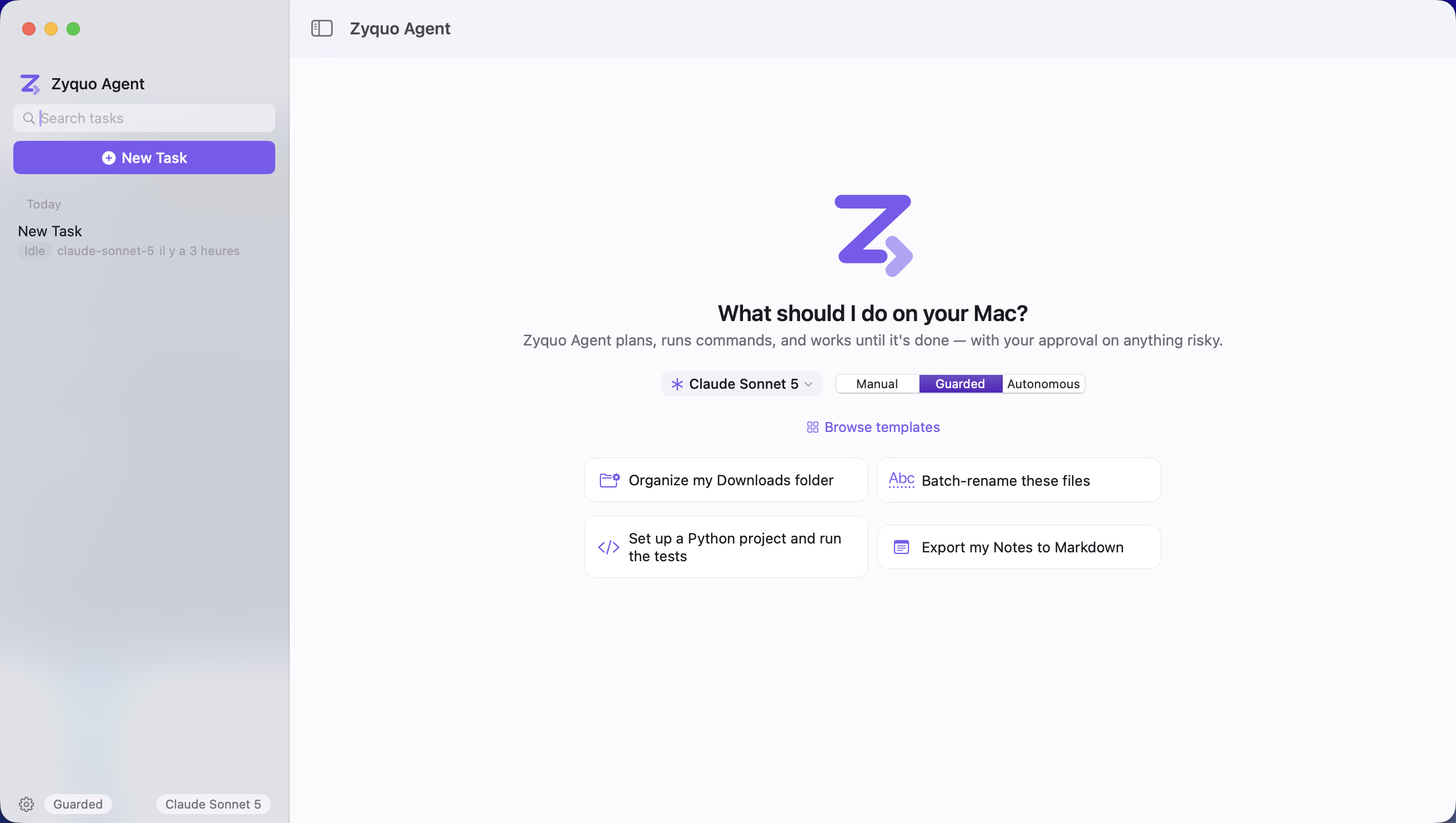
### The command center at rest
### A real run: step cards, live terminal feed, budget meters
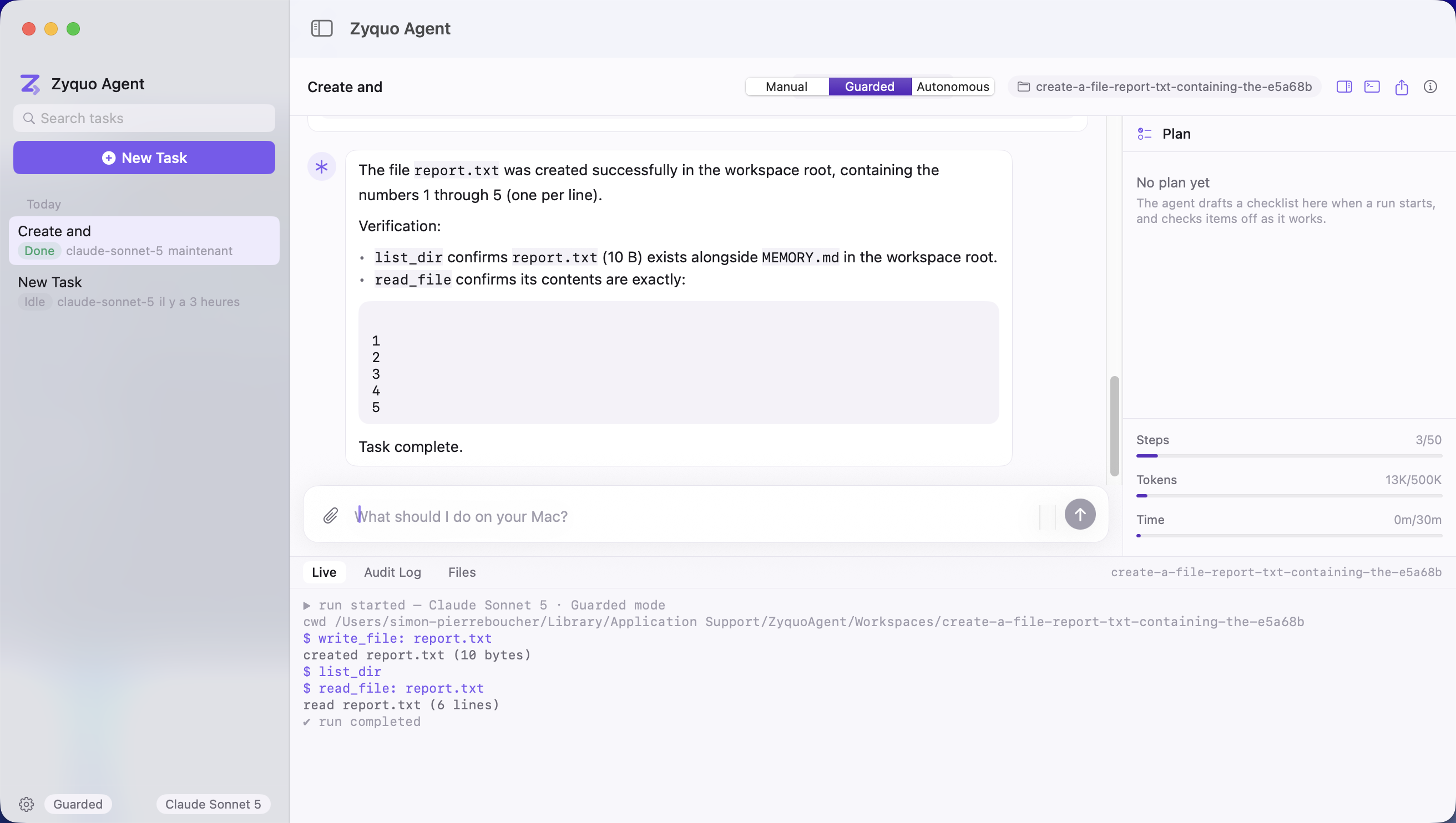
*The agent wrote a file, then verified it with `list_dir` and `read_file` before answering. The drawer streams every action as it happens; the right panel tracks steps, tokens, and time against your budgets.*
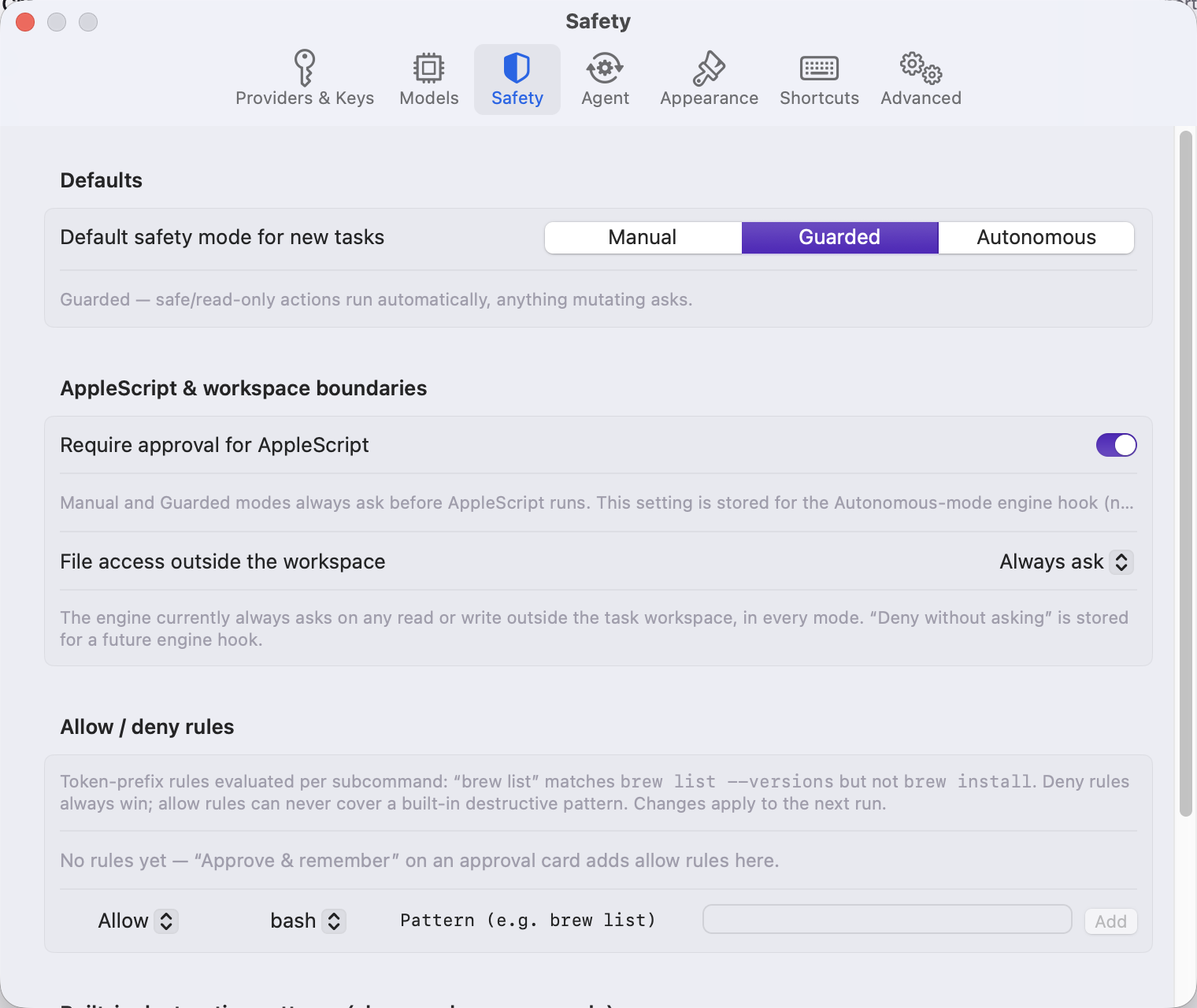
### Safety settings: modes, boundaries, and your own allow/deny rules
---
## 🚀 Features
### The agent engine
| | |
|---|---|
| 🔄 **True agentic loop** | A `stop_reason`-keyed while-loop (`AgentLoop`, a Swift actor): stream a model turn → execute its tool calls → thread the results back → repeat until the model answers without calling tools. Handles truncation, refusals, and transient provider errors (one automatic retry with backoff). |
| 🧠 **Reasoning-model aware** | Thinking/reasoning tokens stream into a collapsible section, separate from the answer. |
| 📋 **Live editable plan** | The agent maintains a real checklist through an internal `update_plan` tool — items go pending → active → done/failed, persisted to `.zyquo/plan.json`, rendered in the Plan panel, and **editable by you** mid-run. |
| ♻️ **Re-planning on failure** | A failed step doesn't derail the run: the agent self-critiques, revises the plan, and continues. (Verified end-to-end: [scenario s6](docs/EVALUATION.md).) |
| 🛑 **LoopGuard** | Step / token / wall-clock budgets plus **repetition** detection (same failing call 3×) and **stall** detection (6 steps with no progress). On a trip it **pauses and asks you** — never silently spins or aborts. |
| ⚡ **Streaming everything** | Text, thinking, and even partial tool-call *arguments* stream live, so you watch the command being composed before it runs. |
| ⏹️ **Real cancellation** | ⌘. (or SIGINT on the CLI) cancels the model stream **and kills the running child process** (SIGTERM → SIGKILL), recording a `cancelled` outcome. Verified by test. |
### The tools it can actually use
| Tool | What it does |
|---|---|
| `bash` | Runs commands via `/bin/bash -lc` with the workspace as cwd. Line-by-line `stdout`/`stderr` streaming, per-command timeout, exit code capture, 200 KB output cap with truncation notice, fully cancellable. |
| `osascript` | Executes AppleScript to automate macOS apps (Finder, Notes, Mail, Calendar, System Events…). Detects TCC denials and explains how to grant Automation access. |
| `read_file` | Reads a file with offset/limit paging (50 KB per call cap). |
| `write_file` | Creates or overwrites a file, tracked in the workspace. |
| `edit_file` | Exact-unique string replacement — **fails loudly** if the target text matches zero or multiple times, so edits can't silently hit the wrong line. |
| `list_dir` | Directory listing with optional depth. |
| `search_files` | Grep-like content search returning `file:line` matches, capped. |
| `update_plan` | Internal (never touches the policy gate) — how the agent maintains its checklist. |
Adding a tool is deliberately trivial: conform to the `Tool` protocol (name, description, JSON-Schema parameters, `execute`) and register it in `ToolRegistry`.
### 🛡️ Safety: the headline feature
This is the part most agent tools treat as an afterthought.
**Three modes, switchable per task, always visible in the header:**
| Mode | Behavior |
|---|---|
| **Manual** | Every gated action asks first. |
| **Guarded** *(default)* | Curated read-only commands and in-workspace file writes run automatically; anything mutating asks. |
| **Autonomous** | Runs freely within budget — **except** the always-ask class, which still asks. |
**The gate itself** (`PolicyEngine`, a Swift actor) evaluates `deny → ask → allow`, **per subcommand**:
- 🔍 **Commands are parsed, not pattern-matched.** Compound lines split on `&&`, `||`, `;`, `|` and newlines (quote-aware); `$(…)`/backtick substitutions are extracted and classified too; wrappers (`env`, `nohup`, `time`, `xargs`, `nice`) are stripped first. The verdict is the **most severe** across all subcommands — `ls && rm -rf ~/x` asks, because the second half asks.
- ⛔ **Hard denies** that no approval can unlock: `rm -rf /` and equivalents, fork bombs, `mkfs`, `diskutil eraseDisk`, writes to `/System`.
- ⚠️ **Always-ask circuit breakers, in *every* mode including Autonomous:** any `sudo`, `rm -rf` outside the workspace, `curl … | sh`, overwrites outside the workspace, `kill`/`pkill`, `defaults write`, `launchctl`, `csrutil`, `chmod -R` outside the workspace, writes to `/Library` `/usr` `/etc`, `git push --force`, `shutdown`, `security`, and AppleScript containing `with administrator privileges`.
- 🚫 **`sudo` is never run silently.** Ever. Proven by a test that *forces* a `sudo` tool call and confirms denial in all three modes.
- ✅ **Inline approval cards** show the exact payload, the risk level and reason, the cwd, and the agent's stated intent — with **Approve**, **Approve & Remember**, **Edit** (re-classified after your edit), and **Deny**.
- 📝 **"Approve & remember"** stores the *narrowest* token-prefix rule (`brew list` matches `brew list --versions`, never `brew install`) — and a remembered rule can **never** override a circuit breaker.
- 📜 **Append-only audit log** (`.zyquo/audit.jsonl`) records every executed action: timestamp, kind, exact payload, cwd, ruling, exit code, truncated output. Viewable in-app, exportable.
Pattern matching is treated as UX, not a security boundary — it's paired with workspace scoping, human approval, and a complete audit trail.
### 📁 Workspaces
Every task gets its own directory under `~/Library/Application Support/ZyquoAgent/Workspaces/`. `bash` runs there; file tools are scoped there by default and **escaping requires explicit approval**. Created and modified files are tracked with badges, checkpoints can snapshot the agent's work, and reopening an old task restores its workspace and full step history.
### 🗜️ Memory & context compaction
Long autonomous runs don't fall off the context window:
- Live token accounting, calibrated by the provider's own usage numbers.
- At **85%** of the model's context, older completed steps are summarized into one compact record by the *same* model (with a mechanical fallback) — while the task, the plan, `MEMORY.md`, and the **most recent 6 steps stay verbatim**. A thrash guard enforces a minimum gap between compactions.
- 📤 **Output offloading:** any tool result over 8 KB is written to `.zyquo/outputs/` and replaced in-context by its first ~40 lines plus a path the agent can re-read on demand.
- 📌 **`MEMORY.md`** lives in the workspace root and is owned by the agent — it records durable facts that survive compaction *and* whole sessions.
*Verified live: a task that triggered **4 compactions** still produced a fully correct result.*
### 🖥️ The command-center interface
- **Sidebar** — tasks grouped Pinned / Today / Yesterday / Previous 7 Days / Older, each with an animated status pill (Planning · Running · Awaiting approval · Done · Failed), model badge, and a live activity indicator.
- **Conversation column** — your prompts as bubbles; the agent's work as **step cards**: thought line, tool chips, the exact command in monospace, color-coded streaming output, exit codes, expandable truncation, collapsible thinking, and inline approval / guard-trip / compaction cards. Final answers render as full Markdown with syntax-highlighted code.
- **Plan panel** — the live checklist with animated check-offs, a progress bar, and step/token/time meters against your budgets.
- **Activity drawer** — three tabs: **Live** (raw streaming terminal feed with cwd), **Audit Log** (every executed action), **Files** (workspace tree with created/modified badges, preview, reveal in Finder).
- **Header** — editable title, model picker (all 170 models, agent-capable ones emphasized), the safety-mode segmented control, workspace chip, export, and an info popover showing the actual system prompt and budgets.
- Light theme is the flagship; a deep plum-charcoal dark theme is derived from the same tokens. Five accent colors.
### 🎯 Productivity
- 📚 **29 built-in task templates** across 6 categories — Files & Folders (6), Development (6), Automation/AppleScript (5), Data (4), System Info (4), Writing (4) — with `{{variable}}` fill-in. Plus your own.
- 🎭 **Personas** — a system-prompt addendum, preferred model, and default safety mode, applied per task.
- ⚡ **Quick Task panel** (⌥Space) — a Spotlight-style floating panel that runs a one-off task and can be promoted to a full task.
- 🔍 **⌘K command palette** — fuzzy search over tasks, templates, and actions.
- 📤 **Export** transcripts to Markdown or PDF · 🔎 full-text search across all tasks · 🏷️ auto-generated task titles · 🔔 menu bar extra showing running-task status.
- 🔐 **Encrypted key vault** — AES-256-GCM, HKDF-derived and machine-bound, stored at `~/Library/Application Support/ZyquoAgent/vault.zq`. **Deliberately not the Keychain**, matching the rest of the Zyquo family. Environment variables take precedence at run time.
---
## 🤖 Providers & Models
Zyquo Agent ships the same **170-model catalog** as Zyquo Cloud across **12 providers**, and marks the ~80-model subset that's genuinely suited to multi-step agentic work (strong reasoning + reliable native function calling + adequate context).
| Provider | Provider | Provider |
|---|---|---|
| 🟢 OpenAI | 🟣 Anthropic | ⚫ xAI |
| 🟠 Mistral | 🔵 Google Gemini | 🟡 Alibaba Qwen |
| 🐋 DeepSeek | 🌙 Kimi (Moonshot) | 🔍 Perplexity |
| 🤝 Together AI | ☁️ DeepInfra | ⚡ Cerebras |
Plus **custom OpenAI-compatible endpoints**. Two clients cover everything: a native `AnthropicClient` (`/v1/messages`, `tool_use`/`tool_result` blocks, `input_json_delta` streaming) and one `OpenAICompatibleClient` (index-keyed `tool_calls` deltas, `role:"tool"` messages) — normalized behind a single `ProviderClient` protocol so the agent loop never sees a wire format.
**Every agent-capable model was verified live**, not assumed: **77 of 80 pass** the full battery — receives the schema, emits a valid *streamed* tool call, consumes a threaded `tool_result`, and produces a correct final answer. Full per-model table with latencies: **[docs/VERIFICATION.md](docs/VERIFICATION.md)**.
Two real provider quirks were found and fixed in the process:
- **Gemini 3+ thought signatures** — Gemini rejects a threaded tool result if the originating call's opaque `thought_signature` isn't echoed back verbatim; it's now captured and round-tripped.
- **OpenAI GPT-5.4+** — `/chat/completions` refuses function tools unless `reasoning_effort` is `none`; the client now downgrades it automatically when tools are attached.
The 3 remaining failures are external and documented: DeepInfra's two Gemini re-hosts strip Google's required signature (the same models work via the native Gemini provider), and `kimi-k3` is capacity-throttled upstream.
Default agent model: **`claude-sonnet-5`**.
> 🔑 **Bring your own keys.** Zyquo Agent ships with none and talks only to the providers you configure.
---
## 💾 Installation
### Option 1 — Download the DMG *(recommended)*
### **[⬇️ Download Zyquo Agent 1.0.0](https://github.com/spboucher-ai/zyquo-agent/releases/latest/download/ZyquoAgent.dmg)**
1. Download `ZyquoAgent.dmg` from the [latest release](https://github.com/spboucher-ai/zyquo-agent/releases/latest).
2. Open it and drag **Zyquo Agent** to your **Applications** folder.
3. Launch it. **No Gatekeeper warning, no right-click-to-open workaround** — the app is signed with a Developer ID, notarized by Apple, and stapled:
```console
$ spctl -a -vv "/Applications/Zyquo Agent.app"
/Applications/Zyquo Agent.app: accepted
source=Notarized Developer ID
origin=Developer ID Application: Simon-Pierre Boucher (3YM54G49SN)
```
4. Open **Settings → Providers & Keys** (⌘,) and paste at least one API key.
### Option 2 — Build from source
See [Building from Source](#-building-from-source).
### First-run permissions
The first time the agent runs AppleScript against another app, macOS asks for **Automation** permission. If you deny it, grant it later in **System Settings → Privacy & Security → Automation**; the app explains this inline when it hits a TCC denial.
---
## ⚙️ Requirements
| | |
|---|---|
| **macOS** | 13.0 Ventura or later |
| **Architecture** | Apple Silicon *or* Intel — the release is a Universal binary (`arm64` + `x86_64`) |
| **Disk** | ~15 MB for the app, plus whatever your task workspaces use |
| **API key** | At least one from a supported provider (BYOK — none included) |
| **Network** | Only to the providers you configure |
| **To build** | Swift 6 command-line toolchain. The **Xcode IDE is not required**; `rsvg-convert` (Homebrew) only if you regenerate the icon. |
Runtime dependency: exactly one — [`swift-markdown`](https://github.com/swiftlang/swift-markdown) for rendering. Everything else is Foundation, SwiftUI, AppKit, and CryptoKit.
---
## 📖 Usage
### Your first task
1. Press **⌘N** (or click **New Task**).
2. Pick a model, and a safety mode — **Guarded** is a sensible default.
3. Describe the outcome you want, not the commands. Press **⌘↩**.
4. Watch it work. When an approval card appears, read the command, then **Approve**, **Edit**, or **Deny**.
Good first tasks (all shipped as templates):
```
Organize my Downloads folder by file type into subfolders
Set up a Python project with a venv, add pytest, and run the tests
Find every file over 100 MB in this folder and summarize what's using space
Batch-rename these screenshots to a YYYY-MM-DD-description pattern
Read this CSV and give me totals per category
Export my Notes to Markdown files
```
### Choosing a safety mode
| If you… | Use |
|---|---|
| are trying it out, or the task touches anything you care about | **Manual** |
| want it to move but keep your hand on anything mutating | **Guarded** ✅ |
| have a long, well-understood, low-stakes task | **Autonomous** |
In all three, destructive and elevated actions **still** require your approval.
### Keyboard shortcuts
| Shortcut | Action | | Shortcut | Action |
|---|---|---|---|---|
| `⌘N` | New task | | `⌘K` | Command palette |
| `⌘↩` | Run | | `⌘F` | Search tasks |
| `⌘.` | Stop | | `⌘⇧A` | Open audit log |
| `⌥Space` | Quick Task panel | | `⌘⇧E` | Export transcript |
| `⌘,` | Settings | | | |
### The command-line interface
The app binary doubles as a headless CLI — useful for scripting and CI:
```bash
BIN="/Applications/Zyquo Agent.app/Contents/MacOS/ZyquoAgent"
# Run a task headlessly, with live rendering and stdin approval prompts
"$BIN" --run "summarize the largest files in this folder" \
--model claude-sonnet-5 --mode guarded --workspace ~/scratch --max-steps 20
# Scripted runs: auto-approve mode-driven prompts.
# NOTE: --yes never auto-approves the always-ask class — those are auto-DENIED
# unless you additionally pass --allow-destructive.
"$BIN" --run "…" --yes
"$BIN" --load-vault # import provider keys from environment variables
"$BIN" --verify # live tool-calling verification across the catalog
"$BIN" --verify-policy # PolicyEngine safety self-check (38 assertions)
"$BIN" --run-mock # offline engine smoke test, no keys or network
```
Keys resolve from the environment first (`ANTHROPIC_API_KEY`, `OPENAI_API_KEY`, `GEMINI_API_KEY`, …), then the encrypted vault.
---
## 🔨 Building from Source
```bash
git clone https://github.com/spboucher-ai/zyquo-agent.git
cd zyquo-agent
make dev # release build → dist/Zyquo Agent.app (ad-hoc signed) — fast iteration
make run # build, bundle, and launch
make icon # regenerate AppIcon.icns from assets/icon/zyquo-agent.svg
make clean
```
Plain SwiftPM works too:
```bash
export SDKROOT=/Library/Developer/CommandLineTools/SDKs/MacOSX26.sdk
swift build -c release
```
Why SDKROOT is pinned
SDK 27 declares SwiftUI's `@State` and friends as *macros*, and the macro plugin (`libSwiftUIMacros.dylib`) ships only with the full Xcode install. SDK 26 keeps the property-wrapper forms, so a Command-Line-Tools-only toolchain can build the whole app. The `Makefile` sets this for you.
Producing a signed, notarized release
`make release` builds a Universal binary (`arm64` + `x86_64` via `lipo`), assembles the bundle, then signs, notarizes, staples, and verifies it. It requires your own Developer ID certificate and a `notarytool` keychain profile — edit `IDENTITY` and `NOTARY_PROFILE` in the `Makefile`.
```bash
make release # app: sign → notarize → staple → spctl
scripts/notarize.sh "dist/Zyquo Agent.app" "" "" \
Resources/ZyquoAgent.entitlements dmg # …and a notarized DMG
```
The script **fails loudly** unless `spctl` reports `source=Notarized Developer ID`.
> ⚠️ Keep `Resources/ZyquoAgent.entitlements` pure ASCII with no XML comments — the AMFI parser `codesign` uses rejects both.
Running the checks
```bash
.build/release/ZyquoAgent --verify-policy # 38 safety assertions
.build/release/ZyquoAgent --run-mock # offline end-to-end engine test
.build/release/ZyquoAgent --run-ui-smoke # UI state-machine test
scripts/agent-eval.sh all # full live scenario + safety suite (needs keys)
```
`swift test` requires an XCTest-capable toolchain; the XCTest files are there for Xcode/CI, and the executable checks above are the equivalents that run anywhere.
---
## 🏗️ Architecture
**82 Swift files, ~19,000 lines**, no Xcode project file.
```
Sources/ZyquoAgent/
├── App/ @main, CLI modes, SwiftUI shell, menu bar (5 files)
├── Agent/ AgentLoop · Planner · MemoryManager · LoopGuard
│ Transcript · AgentStep · AgentEvent · prompt (8 files)
├── Tools/ Tool protocol · ToolRegistry · ShellTool
│ AppleScriptTool · FileTools (5 files)
├── Execution/ ExecutionService · PolicyEngine · AuditLog (4 files)
├── Workspace/ WorkspaceManager (1 file)
├── Providers/ ProviderClient · Anthropic · OpenAI-compatible (4 files)
├── Models/ ToolSpec/ToolCall/ToolResult · AgentTask
│ catalog types · templates (9 files)
├── Services/ ModelCatalog · SecureKeyStore · Streaming (6 files)
├── ViewModels/ TaskStore · RunController · approval bridge (8 files)
├── Views/ Command center, settings, palette, Markdown (25 files)
├── DesignSystem/ ZyquoTheme tokens, components, glyph (4 files)
└── Verify/ Live provider verification harness (1 file)
```
**Design rules that hold throughout:**
- `AgentLoop`, `ExecutionService`, `PolicyEngine`, `AuditLog`, and `WorkspaceManager` are **actors**; structured concurrency everywhere; every long operation is cancellable.
- Shell execution **never** leaks into views or view models — it lives behind `ExecutionService`, and everything passes `PolicyEngine` first.
- The UI renders exclusively from an `AgentEvent` stream and the persisted `Transcript`.
- Every color, font, spacing, and radius comes from `ZyquoTheme` tokens — no raw hex in views.
The architecture traces directly back to research documented in **[docs/AGENT-RESEARCH.md](docs/AGENT-RESEARCH.md)** (413 lines, 79 cited sources), and the provider layer to **[docs/PROVIDER-REUSE.md](docs/PROVIDER-REUSE.md)**.
---
## 🔬 Verification & Evaluation
Nothing here is claimed on vibes — it was measured, and the failures are documented too.
| Suite | Result | Report |
|---|---|---|
| **Provider tool-calling** (live, every agent-capable model) | **77 / 80** green | [docs/VERIFICATION.md](docs/VERIFICATION.md) |
| **End-to-end scenarios** (live, real workspaces) | **11 / 11** pass | [docs/EVALUATION.md](docs/EVALUATION.md) |
| **Safety tests** (live) | **8 / 8** pass | [docs/EVALUATION.md](docs/EVALUATION.md) |
| **PolicyEngine self-check** | **38 / 38** | `--verify-policy` |
Scenarios cover: nested file structures, batch renaming, writing *and running* a Python script, CSV analysis checked against ground truth, largest-file discovery, **re-planning after a deliberate failure**, **forced memory compaction**, AppleScript automation, multi-tool log analysis, and cross-provider parity on a second provider.
Safety tests confirm: `sudo` never executes in any mode (including a test that *forces* a sudo tool call), out-of-workspace deletes are auto-denied, cancellation kills the child process, `rm -rf /` is hard-denied, and no key material reaches any transcript, log, or workspace file.
---
## 🗺️ Roadmap
- [ ] Enforce the two settings that are currently persisted-but-advisory: `requireApprovalForAppleScript` in Autonomous mode, and `workspaceEscapePolicy = deny` *(the engine already asks for AppleScript in Manual/Guarded and always asks on workspace escape — these would add stricter hooks)*
- [ ] Optional **Seatbelt sandbox profile** for Autonomous runs, on top of the policy gate
- [ ] Read-only **explorer sub-agent** that returns summaries without mutating state
- [ ] **HTTP fetch tool** (the `Tool` protocol is built for this)
- [ ] Improve auto-generated task titles — short prompts can produce clipped titles
- [ ] Workspace **checkpoint restore** exposed in the UI
- [ ] Structured exit codes and policy rulings surfaced per step card (currently in the audit log)
- [ ] Re-verify `kimi-k3` when Moonshot's capacity recovers
---
## 🤝 Contributing
Issues and pull requests are welcome.
If you contribute code, please keep the project's conventions:
1. **Every code file starts with the standard header** (name, `Zyquo Agent`, author, mail) — there's a sweep that checks.
2. **Zero build warnings.**
3. **Design tokens only** — no raw hex values or magic numbers in views; add a token to `ZyquoTheme` if one is genuinely missing.
4. **Never bypass the safety gate.** There must be no code path that executes a shell command or AppleScript without going through `PolicyEngine`, and no action that isn't audited.
5. **Never commit secrets.** API keys belong in the vault or the environment. `.secrets/` is gitignored.
6. Before opening a PR, run: `swift build -c release`, `--verify-policy`, `--run-mock`, and `--run-ui-smoke`.
---
## 📄 License
Released under the **MIT License** — see [LICENSE](LICENSE).
---
## 👤 Author
**Simon-Pierre Boucher**
[](mailto:contact@spboucher.ai)
**The Zyquo family** — one design language, three characters
☁️ Zyquo Cloud *(chat)* · 💠 Zyquo Local *(on-device)* · ⚡ **Zyquo Agent** *(autonomous)*
Built on macOS with Swift, SwiftUI, and the command line — no Xcode IDE.
⭐ **If Zyquo Agent is useful to you, a star is genuinely appreciated.**